Structured Pruning of FDNs
A perceptually lossless pruning algorithm for Feedback Delay Networks (FDNs).
Acknowledgements
Karolina Prawda (University of York)
Andy Hunt (University of York)
Sebastian J. Schlecht (FAU Erlangen-Nürnberg)
Mark Rau, RLE (Massachusetts Institute of Technology)
Jatin Chowdhury, RLE (Massachusetts Institute of Technology)
Structured Pruning of Feedback Delay Networks
A perceptually lossless pruning algorithm for Feedback Delay Networks (FDNs).
Background
Feedback Delay Networks
- FDN’s are recursive filters used for artificial reverb and decorrelation.
- Amongst other methods to synthesise reverberation, FDN’s are particularly efficient computationally, nonetheless their time complexity is O(N2).
Here’s a 4x4 FDN:
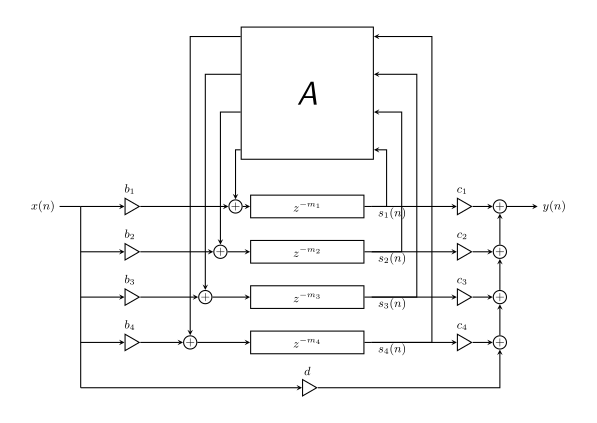
As shown, they consist of a set of delays and a feedback matrix through which the delay outputs are coupled to the delay inputs.
The ideal FDN triad
This thesis formalises a threefold trade-off that’s featured on this line of research since its early days.
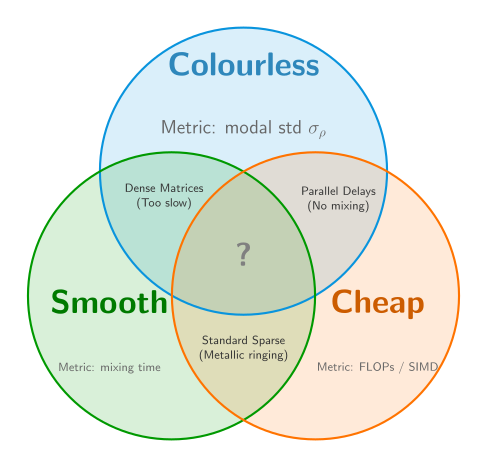
As shown on the diagram, known structures don’t fully satisfy all three requirements simultaneously. This dissertation flips the design approach of FDN’s from a “ground-up” to a “top to bottom” perspective:
What if we start from a differentiable (trained), nice-sounding, dense FDN and try to prune it without losing perceptual/acoustic quality, instead of designing it with the lowest possible N×N feedback matrix?
Benchmark Results
Compiled C++ with ARM NEON intrinsics on Apple M-series, vs Apple Accelerate BLAS. Layer count L chosen per-N by listening test.
| N | L | LSD (dB) | Staged (ns) | BLAS (ns) | Speedup |
|---|---|---|---|---|---|
| 4 | 8 | 0.00 | 1.5 | 36.2 | 25.0× |
| 8 | 6 | 0.90 | 7.1 | 26.7 | 3.8× |
| 16 | 4 | 2.46 | 8.8 | 38.4 | 4.4× |
| 32 | 10 | 0.11 | 56.2 | 71.3 | 1.3× |
| 64 | 3 | 4.25 | 26.2 | 189.6 | 7.2× |
| 128 | 3 | 2.24 | 39.2 | 658.4 | 16.8× |
| 256 | 3 | 1.50 | 75.8 | 1989.2 | 26.3× |
 Singing
 Drums
Drums Orchestral